Drew Ludwig · 2 September 2026
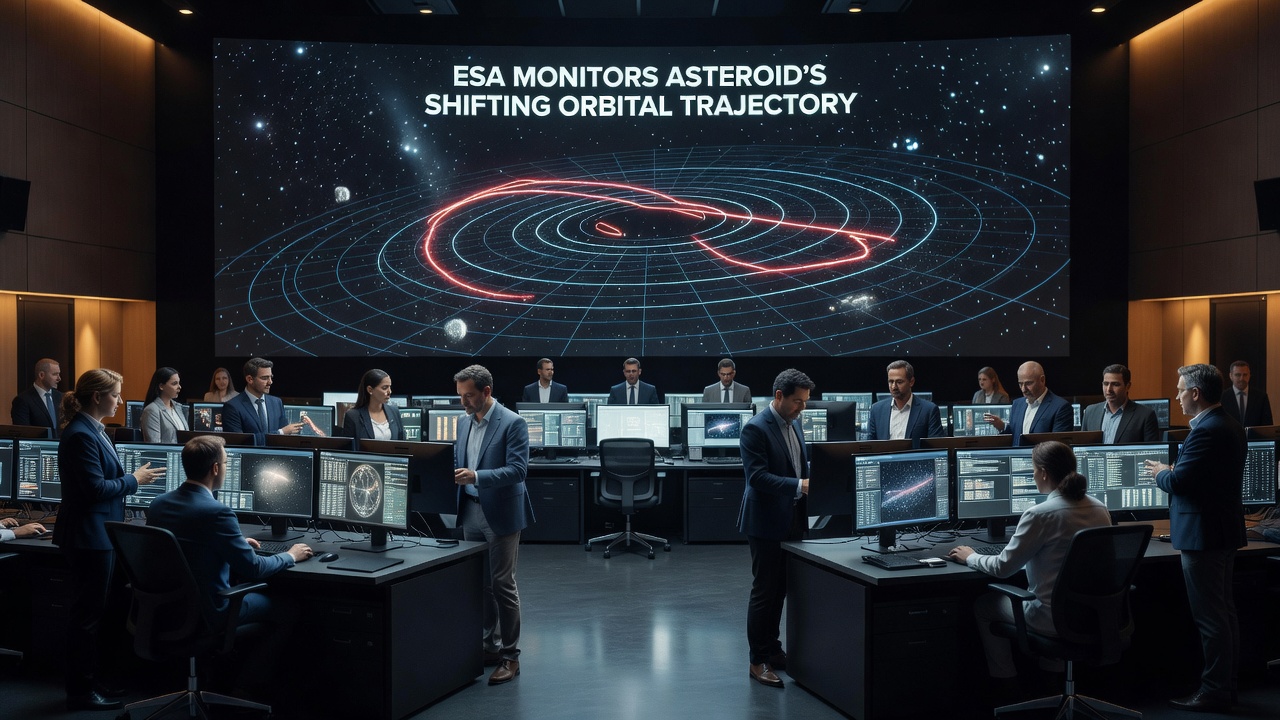
The European Space Agency continues to monitor an asteroid whose orbital path has shown notable variations in recent months. This tracking effort provides valuable insights into the behavior of near-Earth objects and supports global initiatives in space situational awareness.
Tracking Methodology and Findings
Utilizing a network of ground-based observatories and space telescopes, ESA scientists have collected extensive datasets on the asteroid's position and velocity. Initial predictions indicated a stable orbit, yet measurements reveal gradual alterations likely caused by the Yarkovsky effect, where uneven heating leads to thrust-like forces. These changes necessitate updated orbital models to assess potential Earth encounter risks over the coming decades.
Collaborative efforts with NASA and other agencies have enhanced the precision of these observations. Spectral analysis indicates a carbonaceous composition, common among primitive asteroids. Such data informs not only immediate tracking but also long-term studies on solar system formation. Educational resources derived from these missions are increasingly incorporated into advanced studies of celestial dynamics.
Role in Orbital Pathways Education
Orbital Pathways Education programs leverage these real-time developments to illustrate key concepts in astrodynamics and space navigation. Students engage with simulation software that replicates the asteroid's trajectory adjustments, fostering analytical skills essential for careers in the space sector. Coursework includes modules on perturbation theory and observational astronomy, directly informed by ESA's ongoing work.
By examining case studies like this asteroid, learners develop a deeper appreciation for the complexities of orbital mechanics. Internships and research projects often focus on similar topics, preparing graduates to contribute to international space agencies. The emphasis on practical application ensures that theoretical knowledge translates effectively into professional competencies, advancing the field of space education and research. Furthermore, workshops and seminars hosted by educational institutions highlight the latest findings from ESA missions, encouraging student participation in data analysis projects. This hands-on experience is crucial for building expertise in orbital pathway management and prediction techniques.